Why the Moon’s Shape Changes Through the Month
Why the Moon’s shape changes through the month comes down to sunlight and viewing angle. Learn to recognise the phases and choose how to watch them.
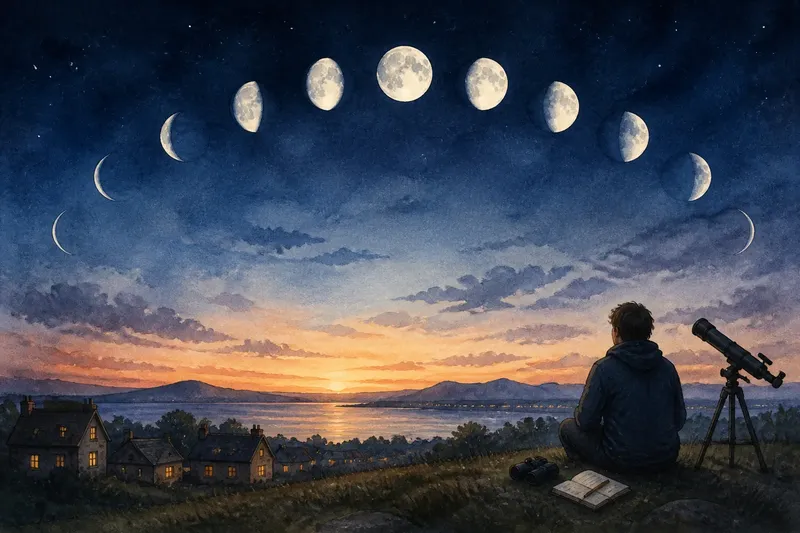
On a clear evening, the Moon may hang above the rooftops as a narrow silver curve; a week later, it can look like a bright round lamp. Why the Moon’s shape changes through the month is a question of sunlight and viewpoint, not a changing lunar surface or, in ordinary phases, Earth’s shadow.
The Moon always has a sunlit half
The Moon does not make its own visible light. Sunlight illuminates one half of it at any given time, while the other half faces away from the Sun. The boundary between those halves is real, but from Earth we see different amounts of the bright side as the Moon travels around our planet.
Imagine holding a ball under a lamp in a dim room. The lamp lights half the ball throughout the demonstration, yet the shape of the lit portion you can see changes as you move around it. The Moon-and-Sun arrangement works on the same basic principle, though the Moon’s orbit carries it around Earth rather than a person walking around a ball.
In space, the Moon is still a globe. The familiar crescent is an appearance created by the angle between the Sun, Moon and observer on Earth. It is not a bite taken from the Moon, and it is not usually the shadow of our planet.
Moon phases follow changing geometry
As the Moon moves along its orbit, its position relative to the Sun changes. When it lies roughly in the direction of the Sun from Earth, its sunlit half faces away from us and the Moon is difficult to see: this is new moon. It is not normally visible as a dark disc against the bright daytime sky because the Sun’s glare overwhelms it.
Over the following evenings, a thin crescent becomes visible after sunset. The bright area grows through the waxing phases. At first quarter, the Moon looks half-lit from Earth; after that, it becomes a waxing gibbous, with more than half of its visible face illuminated.
At full moon, Earth lies roughly between the Sun and Moon, so the side facing us is broadly sunlit. The Moon then wanes: its visible bright portion shrinks through waning gibbous, last quarter and waning crescent, before the cycle returns to new moon. “First quarter” and “last quarter” describe positions in the cycle, not a quarter-lit Moon; each appears about half-lit.
The full cycle takes a little over four weeks. Its exact calendar dates shift, so it is more useful to think of phases as a repeating sequence than as fixed appointments on the same date each month.
Earth’s shadow is not the cause of the phases
It is easy to picture Earth casting a shadow across the Moon as it changes shape. That explanation would make sense if the Moon were being eclipsed each month, but a lunar eclipse is a separate, occasional event. It happens when the Moon passes through Earth’s shadow, and the darkening is temporary rather than a gradual phase sequence.
Most months, the Moon’s orbit carries it a little above or below the exact alignment needed for an eclipse. The phases continue because sunlight illuminates half the Moon while our viewing angle changes. During an eclipse, by contrast, Earth’s shadow can visibly move across the lunar surface.
A useful check is to notice that a crescent can appear in the daytime sky, while the Sun is still visible. Earth’s shadow cannot be responsible for that lit curve: it is the sunlit part of the Moon seen from a different angle.
Choose a way to observe the phases
You can follow the cycle with your eyes alone, use binoculars, or look through a small telescope. Each approach suits a different kind of curiosity; none is required to understand the geometry.
- Unaided eyes suit a simple month-long record. They make the changing outline easy to recognise, especially the crescent and full moon. Note the date, approximate time and direction you looked, then sketch the bright part.
- Binoculars suit close inspection without a complicated setup. The Moon’s craters and shaded regions become more distinct, especially near the boundary between light and dark. That boundary is called the terminator, and its changing position makes the lunar surface look particularly textured.
- A small telescope suits detailed lunar viewing. It can reveal more surface detail, but the Moon may not fit entirely in the field of view at higher magnification. A low-power view is often more useful for seeing the whole disc and its phase together.
Say you want to see how the terminator shifts rather than collect close-up detail. You could begin with unaided sketches on a few clear evenings, then use binoculars when the Moon is half-lit; the expected observable result is a sharper view of the moving light–dark boundary while the overall phase remains easy to compare.
For choosing between these options, start with the question you want the view to answer. To recognise the sequence, use your eyes. To inspect craters along the terminator, try binoculars. Choose a telescope when more surface detail matters and you are comfortable adjusting its view.
When is the Moon easiest to see?
Why does the crescent appear near sunset?
A waxing crescent is positioned near the Sun in the sky, so it is often visible in the west after sunset. It sets not long after the Sun, and the thin bright curve can be subtle against twilight.
Why does the Moon rise at different times?
As the Moon moves eastward along its orbit, Earth has to rotate a little farther before the Moon returns to the same part of the sky. As a result, moonrise shifts later from one day to the next, though clouds and the local horizon can make the timing harder to notice.
Can I see the Moon during the day?
Yes. The Moon is often above the horizon in daylight, particularly around the phases when it is far enough from the Sun’s direction to stand out against the blue sky. Look away from the Sun itself and scan the open sky; never look directly at the Sun through binoculars or a telescope.
Why does the Moon sometimes look like a crescent inside a crescent?
The faint outline around a bright crescent can be the rest of the Moon’s face, lit by earthshine: sunlight reflected from Earth onto the lunar night side. It is not another phase or a second shadow, but a dim glow that is easier to notice when the crescent itself is not too bright.
Read the curve before reaching for equipment
The Moon’s changing shape becomes easier to make sense of once you separate what is lit from what you can see. Watch the bright fraction grow and shrink, and remember that the Sun lights half the globe throughout. For the question of why the Moon’s shape changes through the month, the clearest starting point is often a brief look outside and a note of which way the crescent faces.
Keep the first observation modest: record whether the Moon is waxing or waning, and check again on another clear evening. That small habit connects the phase you see to the Moon’s place in its orbit without requiring a chart, a telescope or a perfectly timed viewing session.