A First Evening with the Summer Triangle
Learn to find the Summer Triangle, follow its changing position through the evening and use its three bright stars to build a simple observing routine.
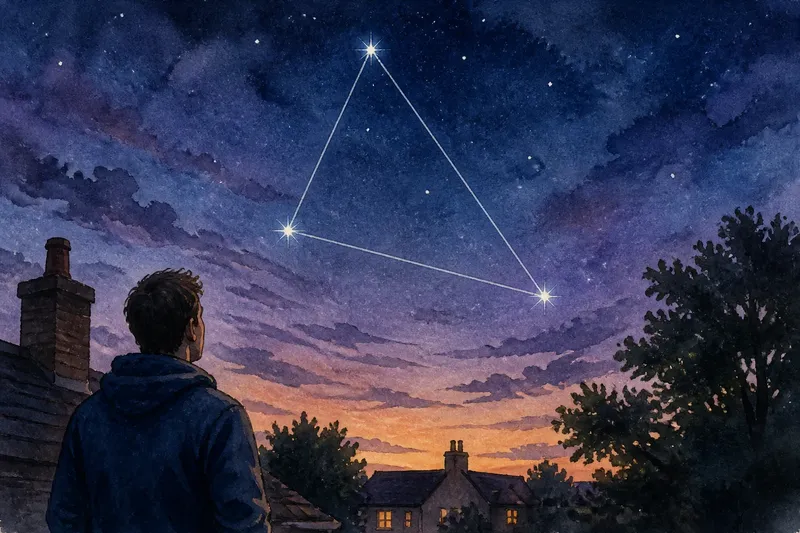
You step outside at dusk and spot Vega above the rooftops, but the rest of the sky is still bright. The Summer Triangle gives you a simple sequence to follow: find Vega, add Deneb and Altair as they emerge, then return to the three-star pattern as it shifts through the evening.
Find the Summer Triangle one corner at a time
The Summer Triangle is an asterism, a recognisable shape made by stars from three different constellations. Its corners are Vega in Lyra, Deneb in Cygnus and Altair in Aquila; they appear to form a triangle from Earth, though they are not close together in space.
Begin with Vega, often the easiest corner to spot on a clear summer evening in the Northern Hemisphere. Once you have it, search farther across the sky for Deneb and Altair, forming a broad outline rather than a tight cluster. If only Vega is visible, let the sky darken before deciding the other stars are missing.
Trace the three sides with your eyes once all the corners are visible. The outline is large, so a quick glance at a small patch of sky can leave one corner outside your view.
Follow a simple observing sequence
Give each part of the pattern a purpose instead of trying to learn every nearby star at once. Start at Vega, move to Deneb, then find Altair and return to Vega along the final side. This repeated route helps you remember the shape and notice when one corner is hidden by a roof, tree or hill.
Next, look at the triangle as a whole and compare its position with a fixed landmark, such as a chimney or the edge of a roof. After a pause, return to the same landmark and see whether the triangle’s angle or height has changed. Earth’s rotation makes the pattern appear to move across the sky during the night.
Imagine you begin with Vega above a chimney, Deneb clear of the roof and Altair behind a tree. You note the missing corner, move to a safe spot with a wider view, and find Altair beyond the branches; later, you compare the pattern with the chimney again and see it at a different angle. The starting point, route and result give you a complete observing session without requiring extra equipment.
Work out why a corner is hard to see
If one star seems absent, check the viewing conditions in a deliberate order. Use this list to decide whether to wait, change position or try again another evening:
- Check whether twilight still brightens the sky; if it does, wait for darker conditions, but if it does not, look for another cause.
- Check whether a roof or chimney covers the expected part of the pattern; if it does, move to a safe place with a clearer view, but if it does not, keep checking the horizon.
- Check whether trees or nearby buildings block the lower sky; if they do, change your viewing position, but if they do not, allow time for the stars to become easier to pick out.
- Check whether you can still identify Vega; if you can, use it as your starting corner and search outwards, but if you cannot, pause and begin again when the sky is darker.
- Check whether you are comparing the pattern with a landmark from the same position; if you are not, return to a familiar spot, but if you are, wait and look again as the sky changes.
- Check whether cloud crosses the triangle; if it does, wait for a clear patch, but if it does not, try a wider view before concluding that a corner is missing.
How does the Summer Triangle change through an evening?
Can I start looking before full darkness?
Yes. Vega may stand out as twilight fades, while Deneb and Altair can be harder to separate from the bright sky. If the shape is incomplete, wait for darker conditions and revisit the same patch.
Can I see the Summer Triangle from a town?
Often, the three bright corner stars remain visible from built-up areas, though street lighting, cloud and nearby obstructions can make them harder to distinguish. Choose a safe open spot and check each corner rather than expecting the whole outline to appear at once.
Does the triangle stay in the same place all evening?
No. It appears to shift and turn as Earth rotates, and its visibility also changes with the season. Compare it with a fixed landmark to notice its movement from your own viewing spot.
What should I do if I can see only two corners?
Use the two visible stars to estimate where the third should be, then check for an obstruction or lingering twilight. If the gap remains hidden, move to a clearer vantage point or return on another evening.
Keep the pattern as your evening’s reference point
After tracing the triangle, spend a moment looking at the surrounding sky, then return to its three corners. That simple rhythm gives your observing session a clear centre without turning each bright point into a separate puzzle.
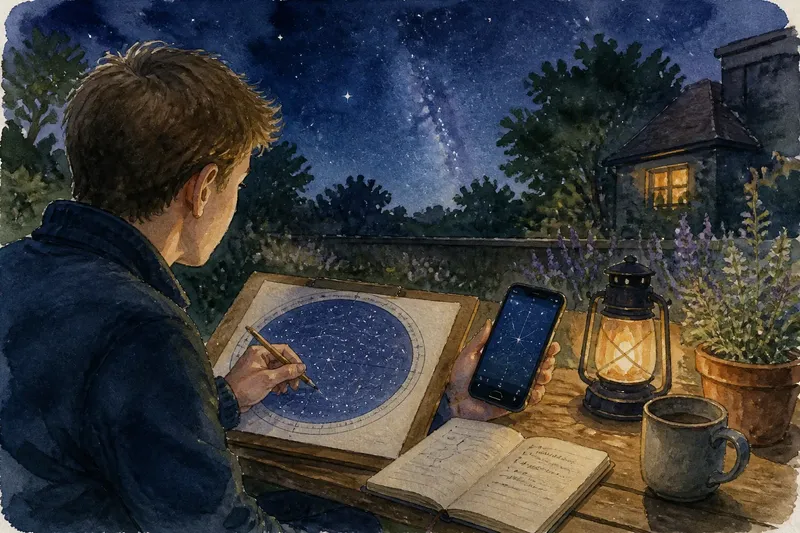
A small notebook can help you record the date, the landmark you used and which corner was easiest to see. If you consult a phone or chart, use it briefly to confirm a star’s name, then look back up and find the pattern again.
Before heading indoors, note whether the triangle has changed angle, moved relative to your landmark or gained a clearer third corner. Searching for the Summer Triangle is easier when you return to the same three stars and let the sky’s changing position become part of the observation.