The Constellation Shortcut That Can Lead You Astray
Constellations are useful for finding your way across the sky, but their stars can be far apart in space. Learn what the pattern can—and cannot—tell you.
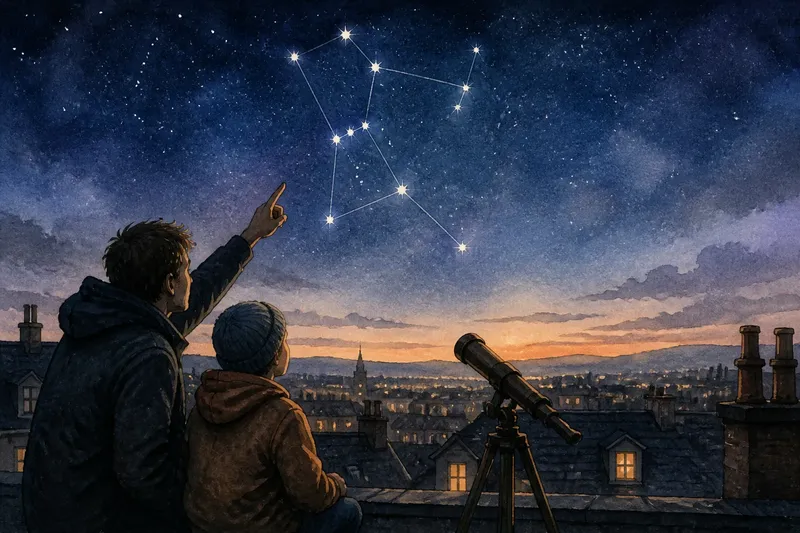
On a clear evening, you spot a familiar shape above the rooftops and point out its brightest star. The constellation makes a neat patch of sky, so it is tempting to imagine its stars clustered together in space. That shortcut can lead you astray: a constellation is a pattern as seen from Earth, not necessarily a neighbourhood of nearby stars.
Understanding the difference does not make the pattern less useful. It gives you two kinds of information instead of one: where stars appear in the sky, and how far away they are in three-dimensional space.
A constellation describes a direction, not a star cluster
When people recognise a constellation, they are looking at the stars’ apparent positions against the sky. The pattern depends on the direction from which we view them, much as distant hills may seem to line up from one spot even though they are separated across a landscape.
That direction is measured across the celestial sphere, an imaginary surface surrounding Earth. A star’s position on this sphere tells you where to look—perhaps towards Orion’s belt or the curve of Scorpius—but it does not tell you how far along that line of sight the star lies.
Constellation boundaries and stick-figure lines are ways of organising what appears overhead. The lines are drawn between selected stars to make a shape easier to recognise; they do not mark physical connections, shared origins or the edges of a real object.
Use a constellation as a signpost in the sky, not as a map of the space behind it.
Apparent closeness and actual distance are different measurements
Two stars can look close together because they occupy nearly the same direction from Earth. One may be much nearer, while the other lies far beyond it. Their apparent closeness is an angle on the sky; their distance is a separate quantity, usually expressed in light-years or parsecs.
This is a matter of perspective rather than an optical trick. Imagine holding a finger in front of your face while looking at a distant lamp. The finger and lamp appear aligned, yet one is close and the other far away. Stars can share a direction in much the same way, though the scale of the distances is vastly greater.
The reverse can also happen: stars that seem widely separated across a constellation may be at comparable distances, or they may be at very different ones. The drawing alone cannot settle the question.
Why does a flat sky make a three-dimensional pattern?
What does a star chart actually show?
A star chart projects positions on the celestial sphere onto a flat page or screen. It is designed to help you identify directions and angular separations, not to show the depth of space. A line between two star symbols is a visual aid, not a route connecting the stars.
Can stars in one constellation be physically related?
Sometimes stars that appear in the same constellation may share motion or have another physical relationship, but the constellation itself does not establish that connection. Astronomers consider additional evidence, such as distance and motion, to assess whether stars belong to a related group.
How do astronomers estimate a star’s distance?
For many nearby stars, astronomers use parallax: the star appears to shift slightly against more distant background stars as Earth moves around the Sun. Other methods are used for greater distances. A star’s position within a constellation, on its own, is not a distance measurement.
Would the constellation look the same from another star?
No. From a different viewpoint, the stars’ apparent positions would change because each star is at its own distance and direction. A familiar earthly outline could stretch, shift or disappear altogether.
Parallax reveals the depth hidden behind the pattern
Parallax is the apparent change in an object’s position when viewed from different places. You can notice the effect by holding a thumb at arm’s length and alternately closing each eye: your thumb shifts against the room behind it. The shift is larger for nearby objects than for distant ones.
Astronomers apply the same geometric idea on a much larger scale. They compare a nearby star’s position against more distant background stars from different points in Earth’s orbit. The resulting apparent shift helps establish the star’s distance.
This method also shows why a sky chart and a distance catalogue answer different questions. A chart helps you locate a star relative to other visible objects; a distance estimate addresses how far away it is. Neither kind of information replaces the other.
Think of the chart as a view from Earth, not a cutaway diagram of the stars.
How should you read a constellation without overreading it?
Start by treating the outline as a finder pattern. It helps you learn where a star appears in relation to other stars, and it can make a large sky easier to describe. Then keep the depth question separate: if you want to know whether two stars are actually neighbours, look for distance and motion information rather than inferring it from the drawing.
Say you are using Orion’s belt to locate a bright star nearby on a printed chart. You trace the belt’s familiar line and identify the star by its chart position; the expected result is that you can point to it in the sky. That success tells you the pattern worked as a guide, not that the belt stars and the other star are close together in space.
It helps to notice what a chart does and does not encode. A legend may explain brightness, colour or symbol size, while a separate source may give distance. A flat layout can be clear and accurate for locating objects without representing their true depth.
For a casual observing session, there is no need to turn every constellation into a spatial puzzle. Enjoy the outline, learn its position and let the idea of depth add a second layer when you are curious.
The constellation shortcut is useful when kept in its lane
Constellations remain practical because the sky’s apparent patterns are stable enough to help people recognise regions and communicate where objects appear. Their usefulness comes from being a shared visual map, not from depicting a literal grouping of stars.
So when a constellation looks like a compact family, remember that the eye is sorting directions into a shape. The stars may occupy very different depths, and some may have no physical relationship at all. The constellation shortcut can still guide your gaze; just do not ask it to measure the distance behind the stars.
Next time you trace a familiar outline, ask two separate questions: where does each star appear, and how far away is it? The first belongs to the pattern; the second opens a view into the depth that the pattern cannot show.